



Contact
E-mail :
Bureau : 717
Téléphone : 01 57 27 94 20
Adresse
Institut de Mathématiques de Jussieu - Paris Rive Gauche (IMJ-PRG)Universite Paris Cité - Bâtiment Sophie Germain
8 Place Aurélie Nemours,
75205 PARIS Cedex 13
Boite Courrier 7012
Partial diff. equations
- Kinetic equations : Boltzmann & Landau
- Elliptic and parabolic equations
- Hamilton-Jacobi equations
L’information de Fisher, une des clés de l’équation de Boltzmann
La célèbre équation de Boltzmann quantifie la croissance de l’entropie pour des distributions statistiques dépendant à la fois des positions et vitesses des particules. Son analyse fait un pas notable avec la preuve de la régularité globale pour des distributions indépendantes de la variable d’espace, y compris pour une classe importante d’interactions très singulières. La clé de cet article de Cyril Imbert, Luis Silvestre et Cédric Villani, paru dans Inventiones mathematicae, était d’établir la grande généralité de la décroissance de l’information statistique de Fisher sous l’effet des collisions.
Extrait de l’article publié en ligne par CNRS mathématiques
De Giorgi’s regularity for elliptic, parabolic and kinetic equations
After giving lectures at the University of California, Berkeley, I uploaded some notes to arxiv and HAL.
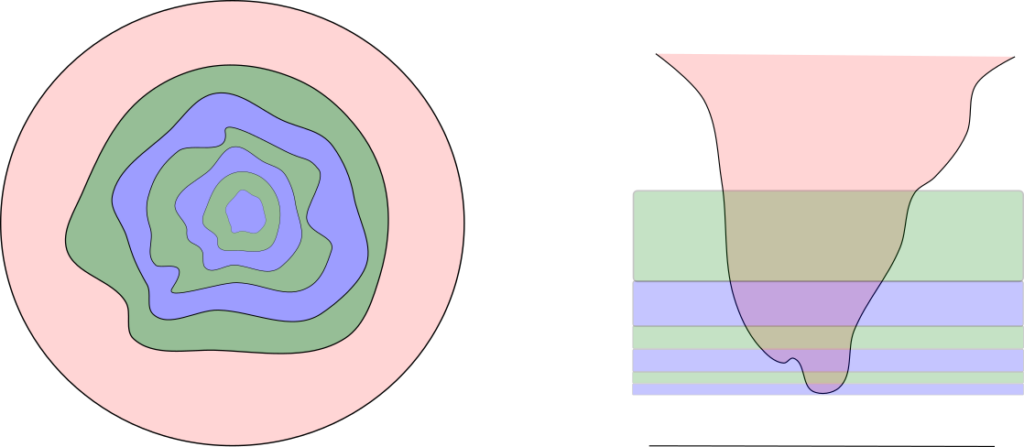
The picture illustrates the iterative procedure in the intermediate value principle (De Giorgi’s second lemma).
Abstract. This book presents a comprehensive regularity theory for solutions of elliptic, parabolic, and kinetic equations. The foundation of this theory was laid by E. De Giorgi’s groundbreaking resolution of Hilbert’s nineteenth problem in 1956. The innovative tools he developed to tackle this problem proved to be remarkably versatile. In 1957, just one year later, J. Nash independently developed analogous techniques for parabolic equations, concurrently with De Giorgi’s research. By the year 2000, these techniques had been extended to address elliptic and parabolic equations featuring integral diffusion, such as the fractional Laplacian. More recently, the theory has evolved to encompass kinetic equations, accommodating both local and integral diffusions. This book aims to present these results in a unified and coherent manner, beginning with the classical elliptic framework and progressing through to the most recent advancements in kinetic equations.
Comment. This first version does not contain results for integral diffusions. I hope I will include them in a second version